Water Reform: New Vision for Water Fails To Deliver
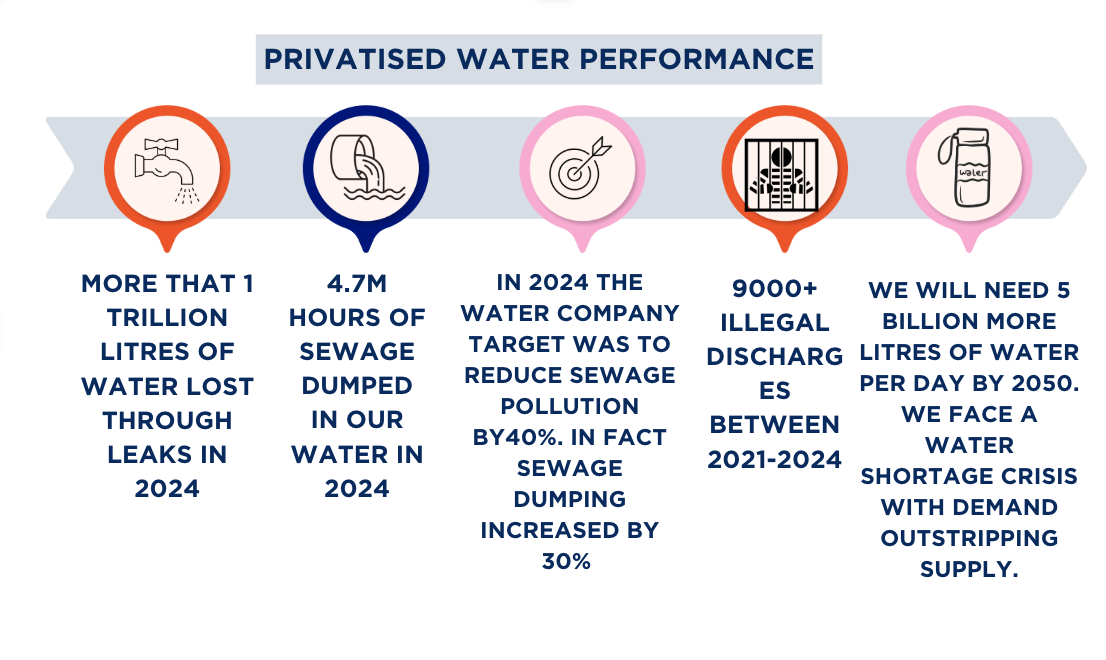
The Water Reform White Paper continues to syphon money off to private equity, inflating the cost of fixing our water system whilst weakening regulation under the cloak of prevention. Dressed up as a once in a lifetime solution, the White Paper masks the fact that it shackles the public to failed privatised water companies with long term increases in bills, increasing numbers of households who can’t pay, and with no end in sight to broken infrastructure and pollution for profit.
Developed by bankers and financiers, the white paper benefits private equity at the expense of the environment and the public, giving the public no say over the future of water and letting illegally polluting water companies off the hook.
Whilst some of the intent will draw across the board support e.g pre-pipe solutions such as sustainable drainage and rainwater management, and measures to support water efficiency (mandatory efficiency labelling), in the overall context of the government’s refusal to address the fundamental problem of failed privatisation and provide solutions to the cause of the terrible state of pollution in this country, these partial changes act as a cover for the failure of this white paper to deliver the ‘once in a lifetime’ radical reform needed to secure water security, clean up our water ways and deliver a sustainable and affordable water system. The elephant in the room is the failed 30 year experiment of privatisation.
1.The Government’s View of The Problem
The White Paper sets out three problems that the government thinks have caused our water system to be in such an appalling state.
- The unstable environment for investors
- The failure of regulation
- The confusion and complexity of legal requirements
These are symptoms dressed up as causes. This pre-determined outcome then blinkered the inquiries that followed, so that the real underlying causes of these problems were not addressed.
1.1 An Unstable Environment
The White Paper is designed to create a stable environment for investors. ‘We want to see stable, predictable, and transparent regulation which provides the low-risk environment that long-term investors look for.’ The water sector in England is and always has been low risk – with predictable and guaranteed income from the public. It is water companies that have created the risk, not the regulators. It is the greed of shareholders and the financial engineering of water companies at the expense of our rivers lakes and seas that has lead to water company neglect of our water infrastructure, illegal pollution, and the destruction of our environment. The failed monopoly privatisation experiment is the cause of the unstable environment for investment, and it is this experiment that must stop. They must not be rewarded with more opportunities to profit and loosening up of regulation and sanctions.
1.2 Failure of Regulation
The white paper sets out to bring regulation closer to the water industry, and reduce the burden of regulatory compliance. Regulatory burden did not cause the problem. Water companies choose not to comply with their statutory duties or the law and they should pay the price. It is the offenders who are the problem. This bill lets them off the hook
It is not possible to regulate a monopoly private water industry (People’s Commission 2025). These companies are not changing in this water white paper – they remain unscathed and no amount of regulatory tweaking will stop them. We have seen that no sanction is enough, information is always hidden, and regulators are always on the back foot faced with an industry owned by profiteering wealthy equity.
The proposals to add regulator accountability for intervening to help ‘struggling’ water companies (who got themselves into that position), determining water company priorities, supervising and tailoring targets for each company, overseeing improvement plans, ensuring financial resilience, overseeing senior leadership; means the regulators are now the fall guys for water company failure.
1.3 Uncertainty in Applying the Law
The White Paper will bring changes to simplify the law and we understand this will loosen interpretation and has the potential to allow more pollution. A recent damning report by the Office for Environment Protection (OEP 2025) sets out how Defra (the department writing this white paper) the Environment Agency and Ofwat have all failed to apply the law. The OEP shows that its not the law thats the problem it is enforcement of the law. We can see this when Emma Hardy, the Water Minister said to the Environment Select Committee that a water company would not loose its license unless water failed to come out of the tap, and you couldn’t flush your toilet. Well that’s happened in Tonbridge Wells and Tonbridge but even in this disastrous situation, water companies remain untouched.
2. Bias and Misinformation in the White Paper
2.1 Bias in the Development of this White Paper
The Cunliffe’s ‘independent’ review is the basis for this white paper.
- The Secretariat was provided by Defra (which has itself been found to have failed to uphold the law by the Office For Environment Protection (OEP2025.)
- Despite promises of transparency it was conducted behind closed doors with Sir Jon Cunliffe spending over 50% of his time in round tables with investors (ICRG 2025).
- None of the investor evidence is published or available (Peoples Commission 2026). In fact the only fully available evidence is the results of the survey to the public. Despite Freedom of information Requests the evidence submitted and used has not been released (People’s Commission FOI)
The Independent Review Terms of reference excluded exploring Public Ownership because the government said that nationalisation is off the table because it is too expensive. This has no foundation. We used an FOI to get the evidence from Defra to support their assertion that water public ownership is more expensive to run than in private ownership. They don’t have the information – so why is the government saying its too expensive when it doesn’t know?.
“We are writing to advise you that the information that you have requested is not held by Defra. This is because the government has no intention to nationalise and therefore has not assessed the ongoing costs of continuing with the current privatised model versus public ownership of the water industry.” (Defra letter to People’s Commission 8th Jan 2026)
Despite this Cunliffe’s report did include some information on public ownership stating that he found no evidence that it provided better outcomes. His evidence for this has not been published, despite it being at odds with academic literature. 90% of the world’s water is in public ownership for a reason – it is cheaper, cleaner and fairer (The People’s Commission on the Water Sector report, July 2025).
The Cunliffe Review asked the public to respond to 70+questions. None of which were on the public’s view about public ownership but again and again in the commentary the public responded that they wanted an end to privatisation and water to be put back into public ownership (Independent Commission 2025}. None of this featured in the final report.
This White PaperDevelopment was through Working Groups set up after the Commission none of which included the public, campaigners or Water NGOs. The public view was excluded. The government has not made public which stakeholders they did consult.
2.2 Misinformation in the White Paper
(a) £104 billion investment actually comes from higher bills
At the Outset the Water White Paper Vision repeats the government claim that is has secured £104bn of new investment. Ofwat has already said that the ‘investment’ actually comes from customer bills
Here are the two links setting out the evidence for your information:
- ‘Ofwat says the allowed bill increases will be used to fund a £104 billion investment in the system’ [Channel4 Fact Check ]
- Previously Ofwat told the City that “PR24 set prices for 2025 to 2030 based on an allowed expenditure of £104 billion of which £90.9 billion is allowed revenue (i.e. from the increase in consumer bills) and the balance is intended to come from shareholder equity”. [PR24 final determinations City briefing 19 December 2024]
(b) The costs of the white paper far outweigh the proposed savings
The government promises to deliver savings of over £125 million on water and energy bills over the next 10 years (thats less than £1 per household per year) through smart meters and labelling household appliances. But this is nothing in the face of money lost by suspending fines.
For example in 2025 Thames was fined £123m for pollution and illegal dividends with Ofwat saying “Our investigation has uncovered a series of failures by the company to build, maintain and operate adequate infrastructure to meet its obligations.” That single fine writes off the total savings in the government’s plan.
(c) Banning the Bonuses is Working
CEOs may not have had bonuses but they have found work arounds through increases in salaries and ‘additional payments’. Banning the bonuses is not working.
David Hinton CEO SE Water, responsible for 30,000 properties two hospitals, a kidney treatment centre, 15 schools, 19 care homes and 29 nurseries in Tunbridge Wells left without water for two weeks and countless businesses affected. He received a £115K bonus this year, and is in line for a 30% increase in salary from April 2025, and If he stays in his job until 2030 will receive an extra £400k just for still being there. He has just had a cash allowance of £50,000 for extra hours put in to deal with the water companies appeal that customer bills are set too low. [BBC News]
Nicola Shaw Yorkshire Water CEO who has overseen Yorkshire Water’s performance being downgraded by the EA from three stars to two, whilst Ofwat says it is lagging behind,; whose serious incidents nearly tripled in 2024, whose sewage dumping of 430,262 hours is primarily due to lack of capacity in their sewage network, and who has under delivered; by 31% on improvement projects, whilst reporting profits year on year – took a £1.5m payment over 2 years in addition to her salary, from the company that sits above Yorkshire Water – Kelda Holdings.
Conclusion
This White Paper is a private equity dream, tying us in for the long term to this failed water industry. 35% of our bills will still go to shareholders, a total of £22bn in 2025-30 and rising thereafter.
Right now we need:
- Defra, EA and Ofwat to enforce the law as it stands, and prosecute criminal offences, force the end to illegal pollution and remove the licenses from illegal water companies
- Take failing water companies into special administration, turn them around into an ownership structure that delivers outcomes and value for money for the public
- A policy of Polluter Pays so the public is not cross-subsiding polluting companies and businesses.
This does not need a White Paper. Whilst putting in place these obvious steps the government should:
- Develop a Strategy for water conservation, protection and efficiency with the public, that sets the direction for what this country needs to ensure we have water now and in the future, and affordably protects our rivers, lakes and seas.
- Undertake a feasibility study that sets out all the delivery options (private, public, mutual ownership) including their costs, and choose the one that best fits the strategic direction.
- Once the ownership model is determined the government can design a regulator fit for purpose.
This sticking plaster white paper is the worst of all worlds, appeasing greedy shareholders, weakening regulatory standards and independence, letting water companies off the hook and leaving the public to pay the price.