This is a story of years and years of campaigning. It is simplified here to respond to the outrageous views being expressed on social media and in the national press that the infrastructure improvements at Ilkley and upstream along the course of the Wharfe are a costly failed experiment.
When we discovered that Yorkshire Water was dumping untreated sewage into our river from the sewage works over 140 times a year, with people picnicking in dry weather beside the river amongst sewage waste on the stones, we assumed, given the legislation (that states untreated sewage can only be discharged in exceptional circumstances) that the regulators did not know the extent of the pollution. Film footage from Beneath British Waters showed the extent of the damage the pollution was doing to the river environment. Our own citizen science testing lead by Prof Rick Battarbee, FRS, Emeritus Professor of Environmental Change at UCL, demonstrated the extent of the sewage pollution. When we found that the Environment Agency was, and still is, issuing a permit allowing this pollution (despite the legislation) we looked for other means to secure a clean-up.
As we investigated further we found non-compliant CSOs (for example grills not complying with standards). We found inaction on the torrents of pollution bursting from the manholes along the riverbank and into the river. This meant people were walking through excrement, sanitary products, and condoms on the riverside footpath. It was clear that Yorkshire Water had neglected its assets, and the regulators were not overseeing the water sector.
The only route open to us to get action from the regulators and Defra was to apply for Bathing Status. Given that we have thousands of visitors to Ilkley, that far exceed the capacity of our Lido in the summer, we knew we would be eligible, as Bathing Status at that time was dependent on how many people were paddling, playing and swimming in the river. On a hot day at its peak we found over 1,500 people by the river enjoying the area.
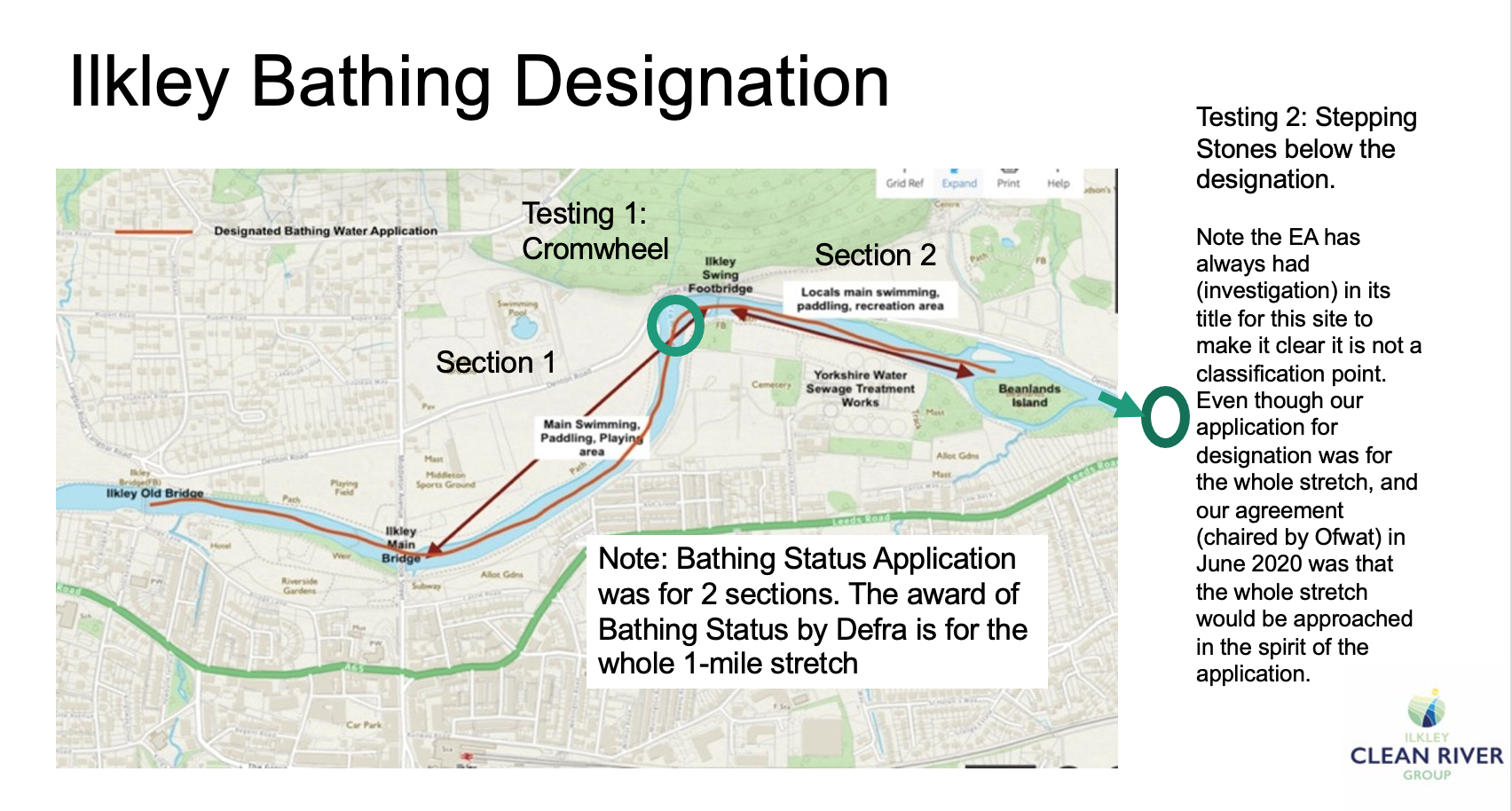
We applied for Bathing Status along a 1 mile stretch which included the malfunctioning CSOs, the bursting riverside pipe and the Sewage works – all in our view neglected rather than maintained as required. Eventually Bathing Status was awarded for our application, but then the EA chose the middle of the stretch (the Cromwheel) upstream of the Sewage Treatment Works as the place it would test the water. At a meeting in 2022 between the CEO of YW, Ofwat, and regional director of the EA, along with our MP and Mayor, we agreed that the application should stand and that the Bathing Status applied to the whole 1 mile stretch not just the point where the EA did its testing.
The EA agreed to test at the bottom of the stretch (albeit not labelling it as Bathing Status testing), and Ofwat instigated its Accelerator Programme so that the stretch including the Sewage Treatment Works could be eligible for improvement immediately. Meanwhile Professor Battarbee instigated a testing project along the whole length of the Wharfe. This was to identify potential sources of faecal bacteria and nutrients upstream and downstream of Ilkley (eg from misconnections, agriculture etc).
All the testing showed how the extent of the opollution from sewage and agriculture varied in different conditions and how even small amounts of rain triggered storm overflow and sewage pollution. It also showed the severity of the pollution from the treated sewage as well as the untreated sewage discharges.
Bathing status gets testing and signage. As well as triggering a clean-up, the signage was really important for our visitor community so that they could know the risks when their children play in the water. When we started this whole campaign, we found people had no idea that they were paddling near an untreated sewage outfall or an equally hazardous treated sewage outfall.
The media focuses on getting to good bathing status. Actually, you just need to get to ‘sufficient’ for people to be able to enjoy the water. We found that, whilst agriculture pollutes the river all the time, it was sewage pollution from CSOs, triggered by rainfall, that caused the most serious events, a conclusion supported by DNA analysis of compliance samples carried out by the University of Sheffield, tipping the water quality from ‘sufficient’ to ‘fail’. See footnotes below for more detail.
Visits by the EA, and particularly Ofwat led to Yorkshire Water putting in an immediate programme of improvements to the CSOs along the whole of the Wharfe upstream of Ilkley, to improve their compliance. They also installed a massive new sewer to stop the bursting pipes along the riverbank and to contain the CSO discharges upstream by acting as a huge storage tank under Ilkley. This brought the upstream infrastructure into compliance.
But more importantly Bathing Status secured the significant improvements at the Ilkley Sewage Treatment Works, (and the Addingham Pumping Station), by requiring the STW to discharge untreated sewage no more than 10 times a year. The new storage tanks, reed beds, and integrated constructed wetland (that is under construction in Ilkley) are intended to secure a dramatic change in pollution and also to improve the treated sewage. This is good news for the River Wharfe. Once we know how this works, and what it costs we can take a realistic view of what it would take to clean up other rivers across the country.
Just to be clear there is no justification for the water companies neglecting the assets that they said they were maintaining (blaming a Victorian sewage system they had been in charge of for 30 years). It wasn’t until the Environment, Food and Rural Affairs Committee of Parliament investigation this year that the true extent of the neglect came to light. Water companies told EFRA that they had not maintained assets, whilst previously telling Ofwat at every review that they were maintaining them (we assume they said this in order to be allowed to take out extraordinary dividends and wrack up debt). 30 years ago, when they were privatised, water companies inherited no debt but now have, as readers will know they have tied bill payers to paying interest on £60+bn (yes BILLION) in 30 years, taking £62+bn (yes BILLION) in dividends over the same period.
The immediate beneficiaries of the improvements we have secured along the Wharfe from the source, including Addingham all the way to Ilkley will be the wildlife in the river as well as the thousands of people who visit the Wharfe upstream – people from Ilkley and the district as well as nationally. But more importantly we are a case study in what is possible. We are proud that our work has helped to generate a national debate on water quality in rivers, and pollution for profit.
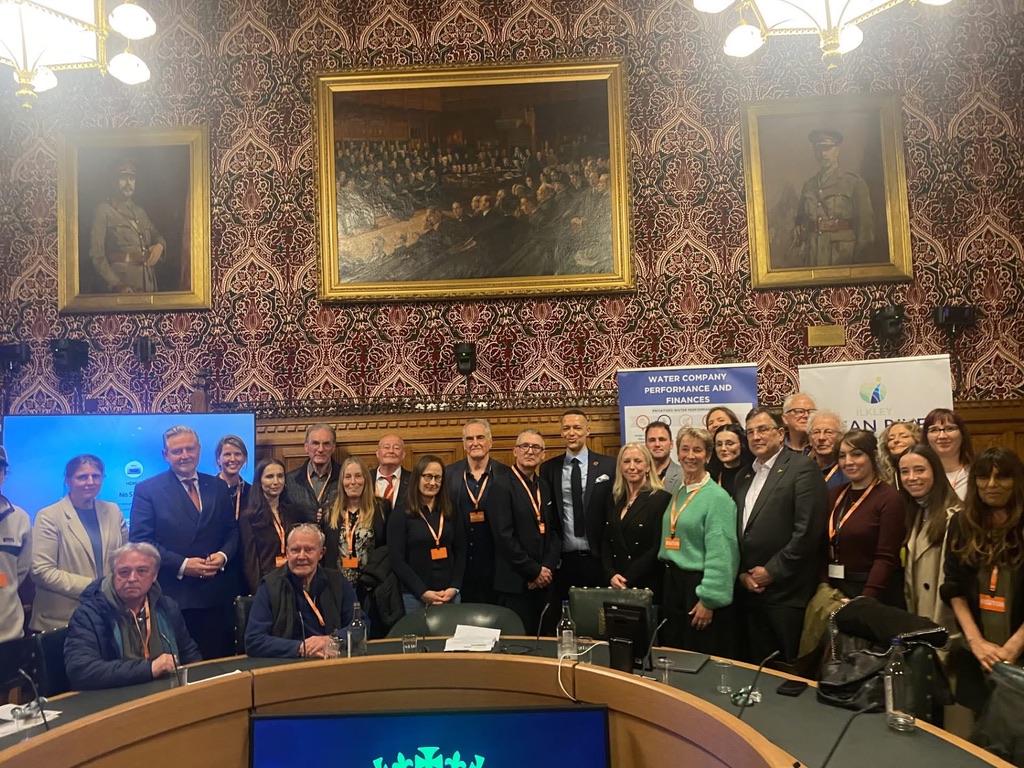
The Ilkley Campaign Group supports hundreds of campaign groups around the country with newsletters, seminars, briefings and protocols. We have taken the case for our rivers to Parliament through our Sewage Campaign Network. We instigated the People’s Commission on the Water Sector supported by local philanthropists, which reported in parliament in July. Our river has now, as a result of this campaign, become one of the most tested rivers in the country, exposing the impact of microplastics and chemicals, as well as bacteria and nutrients. Our aim is for all rivers, lakes and seas to be clean and safe for people and wildlife. We have shown its possible here and therefore possible everywhere.
As to the accusations that Ilkley has benefitted at the expense of more polluted areas – well we are shocked. No pollution outside exceptional circumstances should be allowed. As a nation we have been let down by water companies, regulators and governments. Our rivers, lakes and seas are excessively polluted whilst overseas shareholders have profited from failing to maintain our infrastructure. Putting that at the door of the Ilkley Clean River Group is a poor attempt to detract from the water companies, regulators and governments responsibility to protect our environment and enforce the law.
As for the smear that the river is still polluted despite Bathing Status, of course it is – nothing will change until the upgrades are finished (which are scheduled for 2026). Without Bathing Status nothing would have happened here. The river’s health would have continued to decline, and the outrageous behaviour of all the agencies involved would have remained hidden. When we started this campaign two comments stuck in our minds, one was that of course people know their sewage is being dumped in the river, when the public didn’t know; and the second was that the sewage was not affecting the water quality enough to worry about. The film footage and our testing along with colleagues from York, Lancaster, Sheffield, Manchester shows the extent of the impact of sewage pollution.
Our work has been to secure maintenance of our sewage infrastructure here in Ilkley and upstream from the source; to ensure our water system is legally compliant and to protect our river from the adverse effects of pollution from sewage that should have been treated as well as from treated sewage that needs better treatment. As we uncovered the extent of the underlying issues we have had to step up to work nationally campaigning for regulators to enforce the law, and for the democratisation of our water system. Whilst this campaign has focused on sewage, our own wider work and that of the EA has highlighted the importance of controlling pollutants both from human waste and from agriculture, and the improvements to the CSOs, SOs and STWs that are needed.
Finally, we note our critics previous employment in, and ongoing association with, the water industry.
Further Information on the Data
- Our critics refer to a report from the EA (data 2020, but report dated 2025), which is not sufficient on its own.
- The DNA testing of compliance samples taken in 2023 by Sheffield University shows that the main source of pollution at the Cromwheel is agriculture when it has rained enough cause faecal bacteria from ruminant livestock sewage to be washed into the river but not enough to trigger spills from upstream CSOs and PSOs. However, when rainfall is sufficiently prolonged or intense upstream spills from CSOs are triggered and samples from the Cromwheel are dominated by faecal bacteria derived from sewage.
- There are two standout wet events in the DNA testing with % human at 99% and 93% respectively. Both these coincide with very high E. coli (10,000 and 8,000 cfu/100 mil respectively) and with at least 72 hours of previous rainfall in the catchment. There’s a small ruminant component but that is swamped by human DNA and must be derived from upstream CSOs and the Addingham PSO in particular, again agreeing with our prior work
- The relative contribution of agricultural and sewage-derived pathogens in the water at the bathing site varies constantly according to a wide range of factors including the amount, intensity and location of rainfall in the catchment, the final effluent flows from STWs, and the timing and duration of spills from CSOs upstream. This is clear from the recent EA report and from our own work
- The main issue is what is it that tips the river from pollution that is still tolerable for humans to paddle play and swim, to pollution that is unsafe. Above the Cromwheel up to the source of the river it could be either from agriculture or humans depending on the factors above. Below the Cromwheel, all the way down to
Wetherby and beyond it is human sewage pollution that is doing the damage. - We have been investigating tributaries that look like they are polluted and are still finding mis-connection issues. These were not being noted nor investigated by the EA. Some of these are now being tackled by Yorkshire Water, some remain unresolved with sewage pollution still entering the river. We have to thank the citizen science team for their diligence in investigating pollution along the course of the river.
- Once the upgrades are in place and the sewage infrastructure at Ilkley, Addingham and all the way upstream is compliant with the law, then the spotlight will be on agriculture.
Diagrams

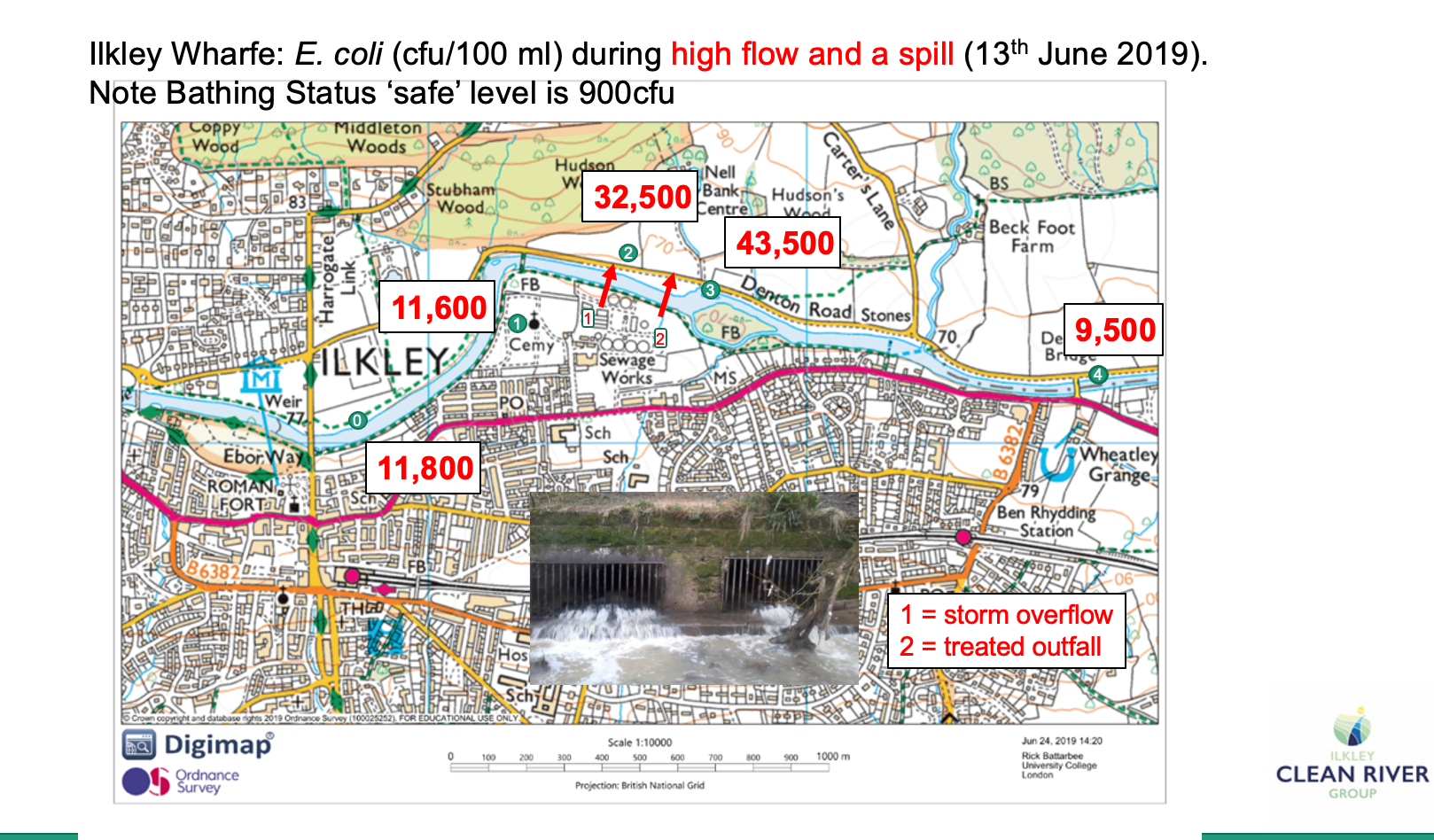
In dry weather the Cromwheel testing point shows that pollution is low and it is safe to paddle, play and swim.It is never safe at the STW and downstream.