
The Cunliffe Commission was supposed to be a once-in-a-lifetime root and branch review of the water sector; a reset to put the whole system on a firm footing for the future; to restore public confidence and ‘attract the investment needed’.
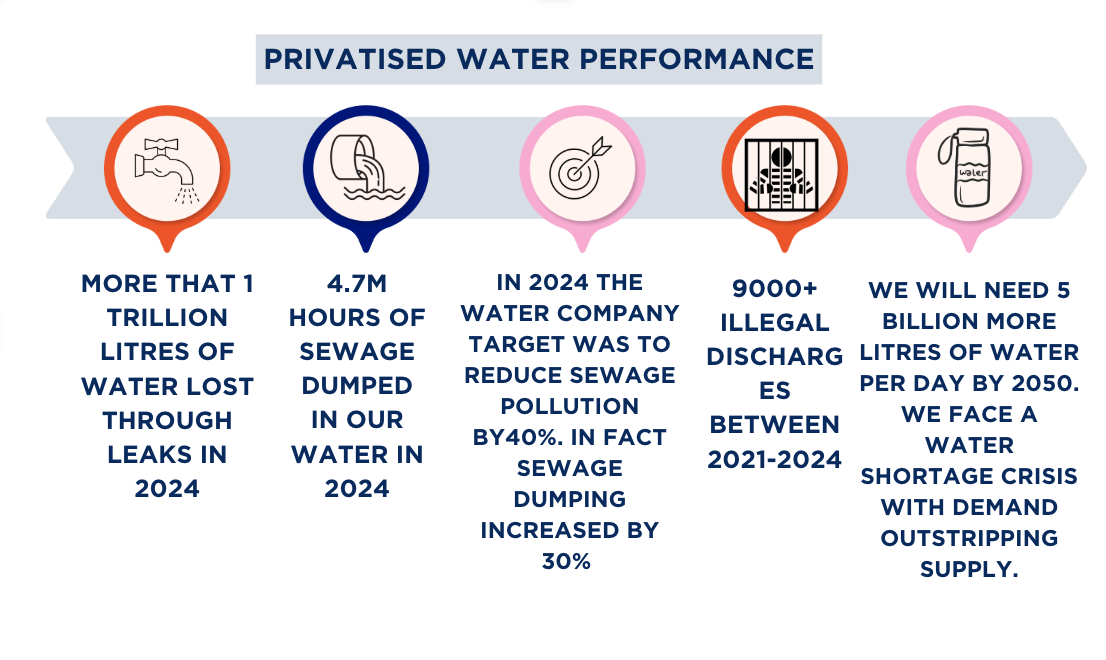
The review has failed to address the issues that are causing the neglect of the environment, the infrastructure, and the extortionate costs to the public. It has shackled us to more of the same. But even worse, it does nothing to secure a resilient water system in the face of growing population demand. It does not address pollution from emerging threats (such as forever chemicals and microplastics), or the unpredictability of climate change. It does nothing to set us on a path for water conservation and protection. The sewage campaign network has set out a critique of the Cunliffe Commission’s findings, comparing them to the People’s Commission (that we are proud to have founded). You can read it here. The highlights of the critique are that:
(1) Privatised water is more expensive than it would be in public ownership,
(2) resigning the public to the role of consumers negates the active role we can all play in protecting our water ways,
(3) rhe privatised system cannot be regulated effectively in a monopoly provider,
(4) there is nothing in the report that restores public confidence or trust, and finally
(5) there is nothing that makes polluters (rather than the public) pay. See our Water Company Rich List for an example of what more of the same looks like.
The bias in the Cunliffe Commission report
We submitted an FOI [1] to find out who the commission had talked to and taken evidence from. This is what we found:
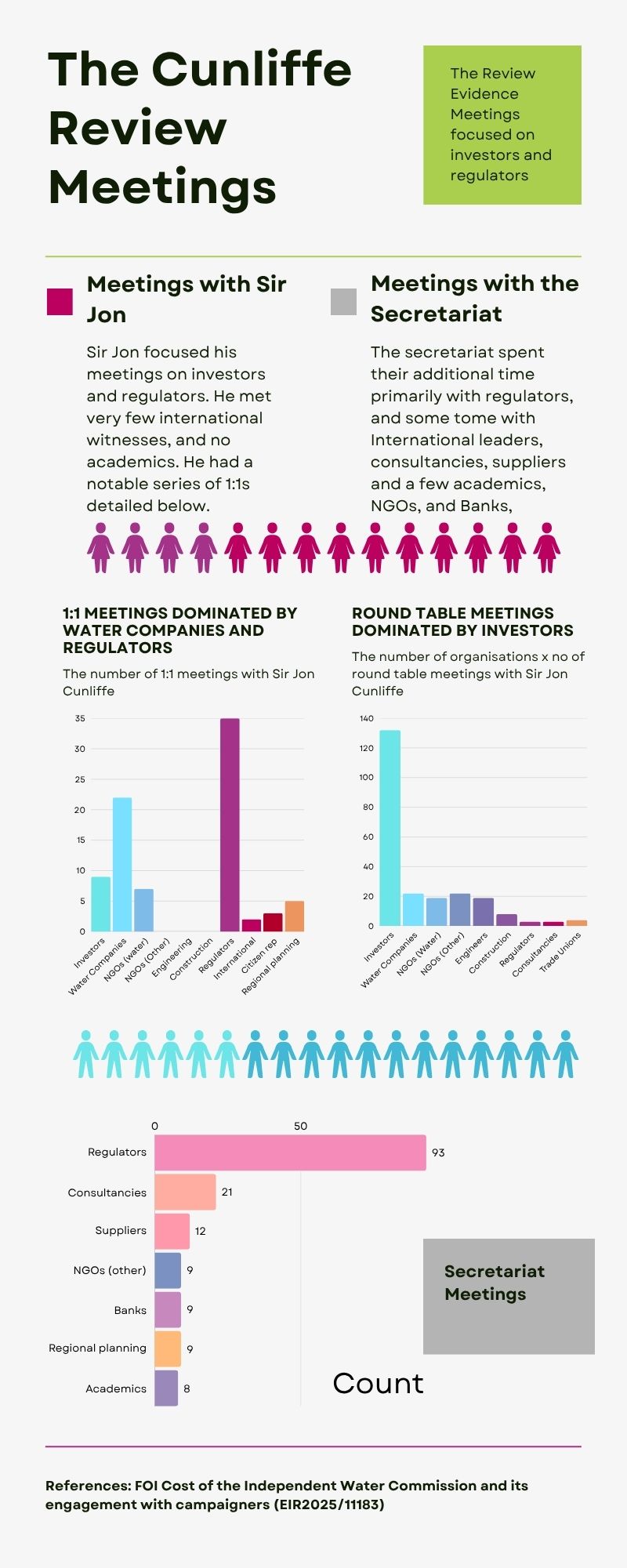
We found that Sir Jon Cunliffe spent most of his time with investors, Water Company CEOs present and past, and regulators. He spent very little time:
- with those who understand the problems, and have solutions for them;
- with those who are showing what ‘better’ looks like;
- with anyone who critiques the status quo or has alternative proposals;
- with anyone who really understands the state of our waterways, and the challenges we face.
Sir Jon focused on what, and who he knew. So, it is not surprising that his report is as it is – ‘improving’ the current system in the eyes of those that already benefit. Ofwat was the scalp the water companies wanted and they got it, alongside looser regulation, permission to persist with extortionate senior management pay, and the public as the cash cows. There is no ambition in the report for a better system fit for the future.
The lack of robust evidence in the report
Throughout his report Sir Jon refers to ‘engagement with the commission’ as the reference for the report’s findings. He doesn’t say what engagement, or with whom. He says he had more than 50,000 responses to the calls for submissions. He refers to 31 of those in the report (see table to insert). There is no list of submissions in the appendices. There is no way of accessing either the submissions or the notes of the ’round table’ meetings. The Commission undertook a public survey and paid a considerable fee of £97,000 for analysis but that analysis is not available. Some campaign groups have sent the People’s Commission their submissions saying (a) they have no idea if it has been read, and (b) it is not available anywhere. Our own submission is not cited, and it turns out from our analysis, neither are any public campaign groups’ submissions.
We have asked DEFRA for the ‘evidence’ that underpins this report to be made public
[1]FOI Cost of the Independent Water Commission and its engagement with campaigners (EIR2025/11183)