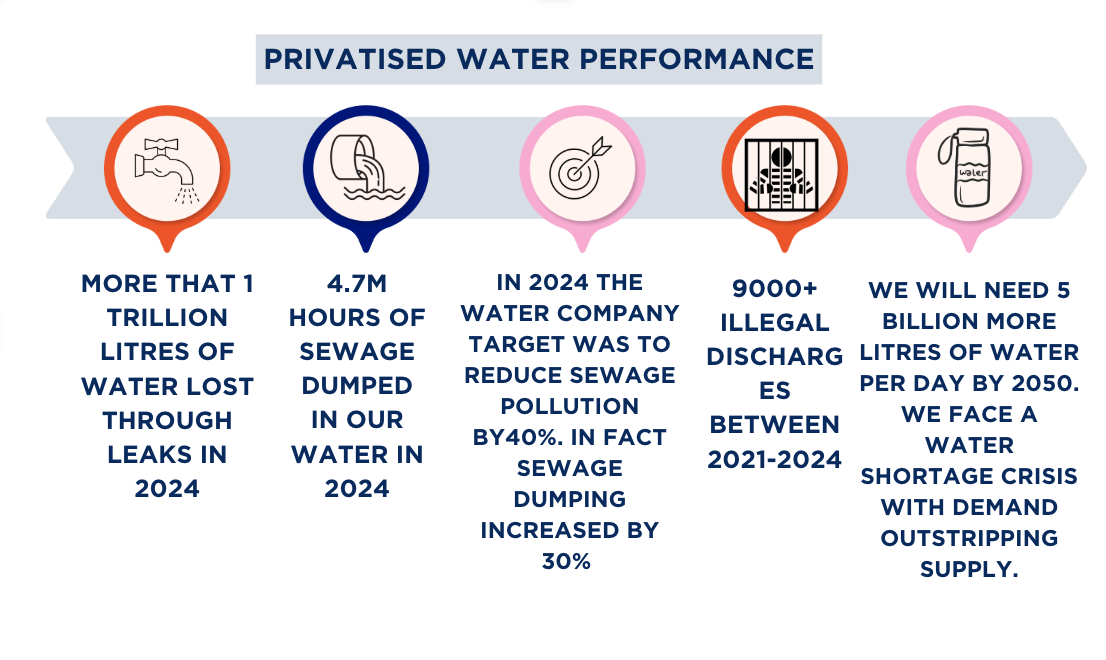
The Government’s White Paper blames the regulators for the failing in our water sector not the profit driven polluting water companies.
Why is that? Why has the government refused to investigate water company failings, refused to punish criminal activities and refused to take back control of our vital infrastructure?
The Problem
Along with
- 2 million Households in Water Poverty, 1 in 5 struggling to pay their bill and arrears at £2m
- 1135 water company criminal convictions with £164m in fines
- £83bn borrowing (its not investment..), £85bn paid out in dividends from our bills, £52bn paid out in interest payments from our bills and a net debt the public apparently still owes shareholders of £200bn
- Water Company CEOs finding work arounds for the ban on bonuses. Rather than ‘saving’ £4m (Ofwat’s calculation) they have accrued millions through other means. See our report on Nicola Shaw’s bonus here
The Investigation
Despite the public uncovering:
- The extent of illegal pollution,
- The lack of financial investment (Panorama provides an example), Stanley Roots evidence to Cunliffe
- Inflation of project costs
and EFRA uncovering the fact that Water Companies have failed to maintain our water infrastructure
and the People’s Commission on the Water Sector setting out clearly that the cause of the problem is the failed privatised monopoly system that predicates private equity over public value and environmental harm, with the solution being:
(A) A national strategy for water with an independent advisory group (SAGE for Water)
(B) Government to use and enforce existing law (The OEP finds Defra, Ofwat and EA have not enforced existing law) to sanction water companies, and take back ownership of failing companies.
(C) A full investigation into the feasibility of public ownership using international examples to design a system for the UK that works for the public and the environment and takes profit
Despite all of this, the government blamed the Regulators.
And whilst regulation has failed as the People’s Commission found, it is impossible to regulate a private monopoly owned overseas. The cause of the problem is privatisation alongside regulatory and policy failure.
The government set up an ‘independent review’ staffed by DEFRA taking any scrutiny of Defra and the Water Company ownership model off the table, despite Defra having been cited by the OEP as failing to uphold the law itself.
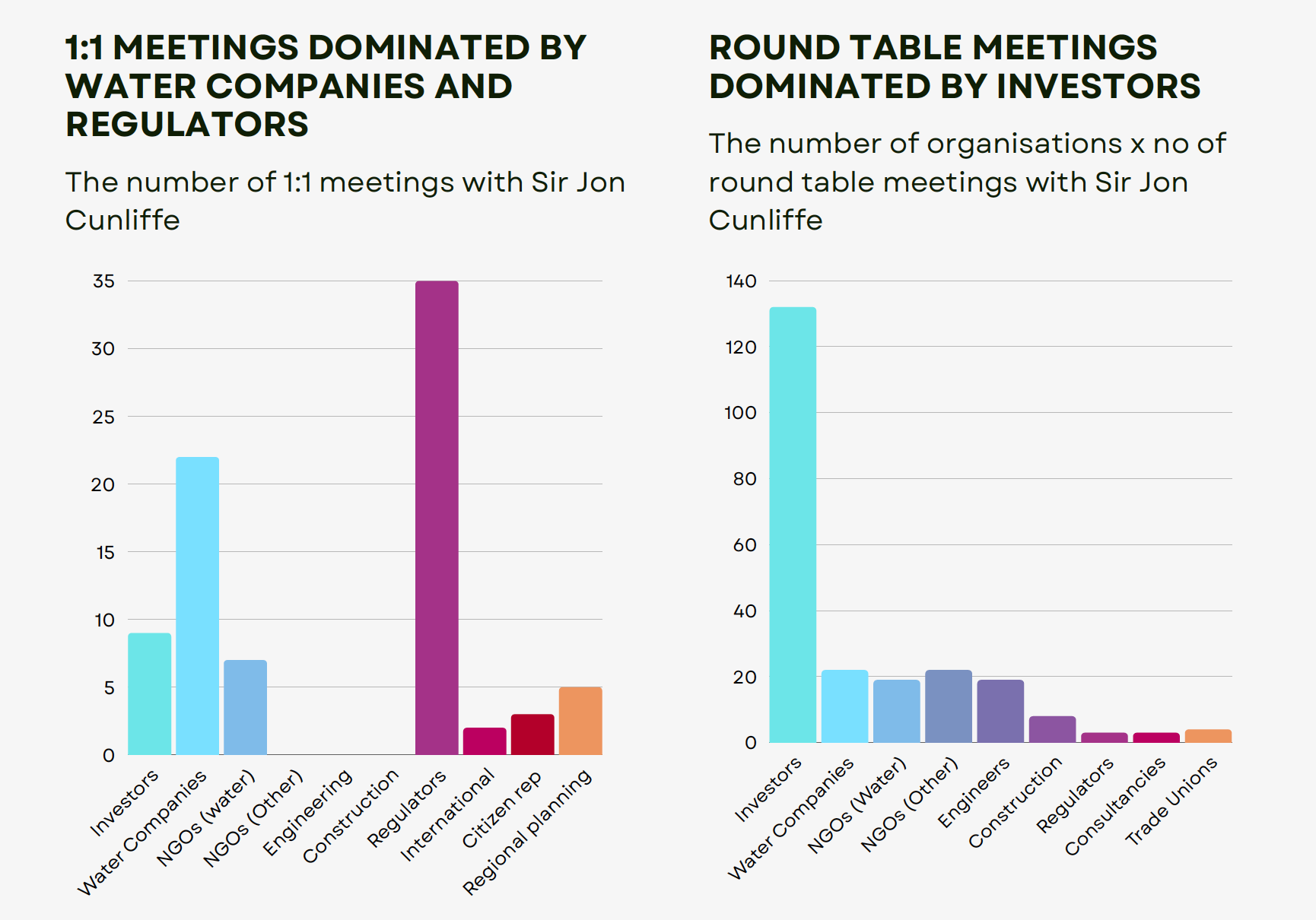
As a result of a Freedom of Information Request we found the Cunliffe Commission to be biased (see our blog). Since then we have failed to secure access to the evidence provided by the investors to the Commission despite our FOIs.
The Cunliffe Review asked the public to respond to 70+questions survey . None of which were on the public’s view about public ownership but again and again in the commentary the public responded that they wanted an end to privatisation and water to be put back into public ownership. None of this featured in the final report.
The White Paper
The white paper ‘New Vision for Water’ repeatedly cites flawed information from the ‘£104bn investment’ that Ofwat has said comes from our bills, to the ‘£4m savings from ban the bonuses’ which has been replaced by additional payments and work arounds.
It does not address the causes of the problem, and does not explore or make way for exploration of Public Ownership despite that fact that 90% of the world’s water is in public ownership for a reason – it is cheaper, cleaner and fairer (People’s Commission report).
The White Paper states (page 16) that after Cunliffe report publication, the government :
“established numerous working groups to ensure a diverse range of stakeholder views were considered in developing our reforms from the outset”.
However the Minister for Water has since said there were no working groups. Our FOI to establish if there were, and who was on them has been rejected as requiring too much Defra time to respond. One thing we know, no water NGOs, Campaigners or public groups have been consulted in the development of the White Paper.
Despite the public paying for the whole water sector, we have no say in the future of our water, and the White Paper gives the public no voice on strategy, water company boards, regulatory bodies, we just get a better ombudsman for when we complain. The public is clear we want our water bills used to pay for our water sector NOT to pay private equity to extract as much money as it can.
Taking ownership off the table saddles us with higher bills, profiteering and reliance on water companies that repeatedly and persistently find ways to pollute for profit
Who benefits? The investors who need to apparently be incentivised to invest; the water companies now let off fines when their performance is poor, and the polluters who still don’t have to pay. Who pays – we do.